
Shoulder pain responds well to personalized, non-surgical care. At Highland Spine + Sport, Dr. Matthew Amos identifies the root cause of your pain and builds a tailored plan using chiropractic care, soft tissue therapy, and dry needling to restore your mobility and get you back to the activities you love.

If reaching for something on a high shelf makes you wince, or sleeping on your shoulder has become impossible, you're not dealing with something you should push through or wait out. Shoulder pain is one of the most common musculoskeletal complaints among active adults, and it almost never resolves on its own without the right care.
At Highland Spine + Sport on Brambleton Avenue SW in Roanoke, we work with active adults throughout the Roanoke Valley, including neighbors from South Roanoke, Cave Spring, Salem, and beyond, who want clear, trustworthy answers about what's happening in their shoulder and a practical path back to full activity.
Here's what this page covers:

The shoulder is the most mobile joint in the body, which makes it powerful and vulnerable at the same time. Pain can follow a single injury or build gradually through months of repetitive strain, poor posture, or unaddressed movement patterns.

The rotator cuff is a group of four muscles and tendons that hold the shoulder joint together and control arm movement. According to the American Academy of Orthopaedic Surgeons, rotator cuff tears become significantly more common in adults over 40, particularly in those who use their arms overhead or lift regularly. You might notice a dull, deep ache, weakness when lifting your arm, or pain that worsens at night. Rotator cuff treatment works best when it starts early, before inflammation and compensatory movement habits make the problem harder to resolve.
Frozen shoulder causes the capsule surrounding your shoulder joint to thicken and tighten, progressively limiting range of motion and intensifying pain. It often develops after an injury, surgery, or a period of immobilization. Without care, frozen shoulder can persist for one to three years. Frozen shoulder treatment works best when it begins before the condition progresses into its most restrictive stage.
Shoulder impingement happens when the tendons of the rotator cuff get pinched between the bones of the shoulder during arm movement. The result is a sharp, nagging pain, especially when lifting your arm overhead or reaching across your body. This pattern is particularly common among runners training for events like the Blue Ridge Marathon, cyclists on local trails, and tennis or pickleball players throughout the Roanoke Valley. Shoulder impingement treatment focuses on restoring proper joint mechanics so tendons move freely again without irritation.
Pain when lifting the arm is one of the most frequent complaints we hear from patients in their 40s and 50s. It's often the first sign that something structural is happening, whether that's a rotator cuff strain, early impingement, or a bursa that's become inflamed. Don't wait for this to become a daily limitation. It's far easier to treat early than after months of compensation.
Not all shoulder pain starts in the shoulder. Nerve irritation in the cervical spine can send pain signals into the shoulder, down the arm, and between the shoulder blades. When the neck and upper back are restricted or misaligned, the nerves that control shoulder function are directly affected. This is one of the most commonly missed contributors to persistent shoulder pain, and it's exactly why a thorough evaluation must always include the neck.
Some shoulder soreness fades with rest. These patterns are different.
Acute shoulder pain typically resolves within six weeks with appropriate care. Chronic shoulder pain lasting more than three months often involves deeper structural or movement-related factors that need professional evaluation.
Seek prompt medical attention if you experience a sudden inability to raise your arm after an injury, significant swelling or bruising, a visible deformity, severe numbness or weakness in the arm, or fever alongside shoulder pain. These may require imaging or specialist referral beyond conservative care.

Many resources you'll find online list shoulder diagnoses, describe anatomy, and stop there. You walk away knowing your condition has a name but not knowing what to actually do about it or whether the care being offered will address what's really driving your pain.
At Highland Spine + Sport, we take a different path. We evaluate how your shoulder moves, how the neck and upper back contribute to the problem, where soft tissue restriction is limiting mechanics, and what your return-to-activity goals look like. That full picture changes everything about how we treat you. Approaches that focus only on the painful joint, without examining the surrounding structures, movement patterns, and contributing spinal factors, often produce results that don't hold.
Our patients don't just get a diagnosis. They get a plan built around their body, their goals, and their life in Roanoke.
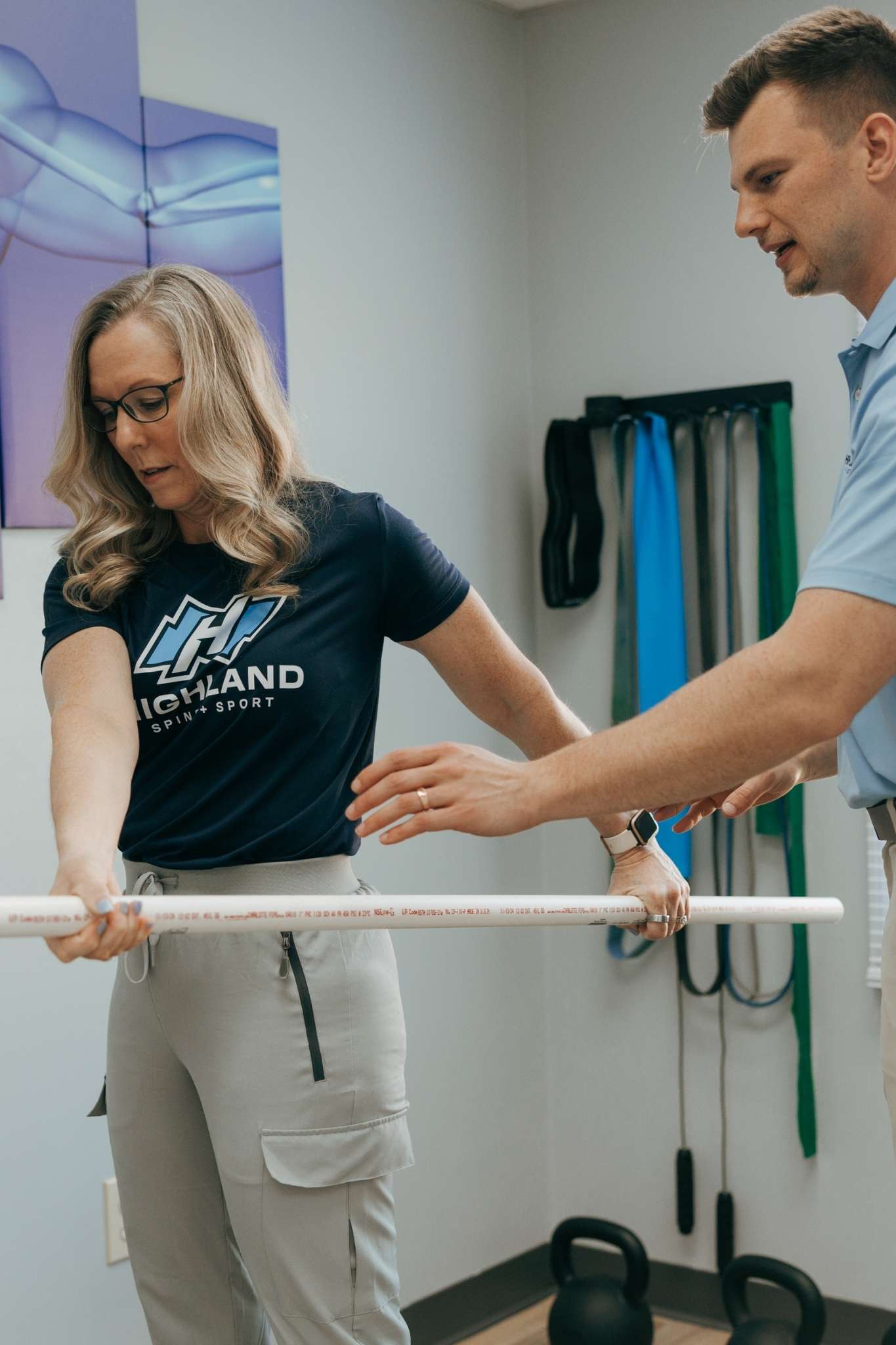
Dr. Matthew Amos builds every treatment plan around your specific diagnosis, movement patterns, and personal goals. Here's how each of our services addresses shoulder pain directly.
Chiropractic care restores proper joint mechanics in the shoulder, neck, and upper back. When the joints supporting shoulder movement function correctly and the nerves feeding the shoulder are free of irritation, pain decreases and mobility returns. Dr. Amos assesses both the shoulder complex and the cervical spine to address neck-related referred pain and impingement driven by faulty movement mechanics. He also identifies the movement habits that caused the problem in the first place so it's less likely to return.
This is particularly effective for shoulder pain when lifting the arm, rotator cuff-related stiffness, impingement, and shoulder pain tied to prolonged desk posture.
Soft tissue therapy includes myofascial release, assisted stretching, and deeper manual techniques that address scar tissue buildup, fascial adhesions, and reduced tissue extensibility around the shoulder joint. It complements our other services by targeting the specific layers of tissue that are contributing to your restricted range of motion or chronic pain pattern.
For patients recovering from frozen shoulder or a rotator cuff injury, soft tissue work restores the range of motion needed for daily tasks and athletic performance.
Dry needling targets trigger points, the tight, hyperirritable knots that develop in the rotator cuff and surrounding shoulder muscles. A thin, solid needle is inserted precisely into the affected tissue, triggering a local twitch response that releases tension, improves circulation, and accelerates healing.
For patients managing stubborn rotator cuff tightness, chronic shoulder impingement, or frozen shoulder, dry needling often provides meaningful relief that other approaches alone haven't achieved. It's especially effective when combined with chiropractic adjustments and corrective exercise.
Between appointments, Dr. Amos gives you specific, progressive exercises designed to strengthen the rotator cuff, improve scapular stability, and correct the movement patterns driving your pain. These aren't generic handouts. They're built around your body, your goals, and your return-to-activity timeline. Our patients consistently tell us that this combination of in-clinic treatment and personalized home exercise is what makes their results last.
Explore our full sports rehabilitation approach to see how we support active adults returning to the activities they love.
If shoulder pain is limiting your workouts, interrupting your sleep, or making ordinary tasks feel difficult, don't wait. Early intervention consistently produces better outcomes
We serve active adults throughout the Roanoke Valley, including Cave Spring, Salem, Vinton, and the surrounding communities. Weekend hikers coming down from Mill Mountain with a nagging shoulder, cyclists finishing long training rides, and desk workers whose shoulder has quietly tightened over months of sitting forward all walk through our door. We meet each of them where they are.
Ready to get answers and a plan? Call us at (540) 339-7911 or schedule your appointment online. Your first visit begins with a thorough movement assessment and a clear, individualized plan. No generic protocols. No guesswork.
Rotator cuff strains and tears, shoulder impingement, frozen shoulder, bursitis, and referred pain from the cervical spine are the most frequent causes in this age group. Gradual degeneration combined with repetitive activity or a prior unaddressed injury often plays a role. A thorough evaluation identifies which structures are involved so treatment is precise, not generic.
A shoulder pain chiropractor in Roanoke evaluates both the shoulder joint and the cervical spine to identify all the contributing factors. Adjustments restore proper joint mechanics, reduce nerve irritation, and improve mobility. Dr. Amos also addresses the movement patterns that caused the problem so results hold over time. We combine chiropractic care with soft tissue therapy, dry needling, and guided exercise for a complete plan.
Conservative care is the appropriate first step for most rotator cuff injuries. That includes chiropractic adjustments, soft tissue therapy to address muscle tension and tissue quality, dry needling for trigger point release, and a progressive exercise plan to restore rotator cuff strength and stability. Surgery is only a conversation after thorough conservative care has been pursued. We'll tell you directly if a referral is warranted.
It depends on the stage of the condition when treatment begins. When addressed early, frozen shoulder often responds within a few months of consistent care. Without treatment, symptoms can persist for one to three years or longer. We combine joint-focused chiropractic care, soft tissue therapy, dry needling, and guided mobility progressions to accelerate recovery at every stage.
Your first visit begins with a detailed conversation about your symptoms, history, and goals. Dr. Amos then performs a movement assessment and orthopedic evaluation to identify the root cause of your pain. You'll leave with a clear, individualized treatment plan, realistic expectations, measurable milestones, and exercises to start right away. See our full conditions we treat page to understand the broader scope of what we address alongside shoulder care.
Absolutely. We work with runners, cyclists, tennis and pickleball players, weekend hikers, and anyone whose shoulder pain is standing between them and the activity they love. Our approach is built for people who want to return to full activity, not just manage pain from the sidelines. Learn more about how we help active adults on our about page.
No. Early intervention is almost always better. If your shoulder is bothering you during workouts, limiting your range of motion, or keeping you up at night, that's enough reason to get evaluated. Don't wait for the problem to become chronic.
Join our email list to stay up to date with the the clinic!